

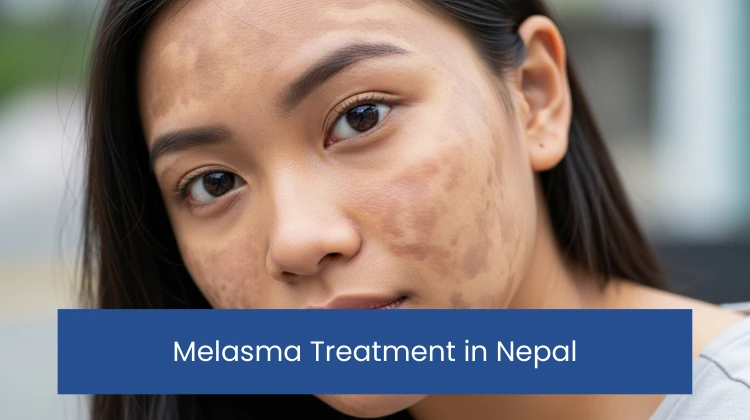
Have dark and uneven patches on your cheeks, forehead, or upper lip that you are wondering about, and how to remove them? They are also called poto, chaya poto, kalo daag, or melasma by doctors. First, get a skin check by a dermatologist, then use sunscreen every day and stick to a plan customized to your skin. In this blog, you will learn about what causes Melasma, how Melasma treatment in Nepal works, the cost of each of them in Kathmandu, and if you are a good candidate for this.
What Is Melasma?
Melasma is a pigment disorder. Your skin cells that produce colour (melanocytes) start to work overtime and produce more pigment, resulting in flat brown to grey-brown patches.
- Where it occurs: cheeks, forehead, nose, chin, and above the upper lip.
- It appears as: flat areas on both sides of the face, in a similar pattern
- How it feels: No physical symptoms, itching, or pain points to something else
- Not all acne marks, sun spots, or damage from steroid cream are considered melasma and require treatment; only a skin exam will tell.
Melasma is common in Nepal. It was reported that melasma is the most frequent diagnosis in 166 of 485 patients with facial pigmentation in a Nepalese study conducted at Nepal Medical College. The same paper references studies estimating pigmentary disorders as 5%-30% of the burden of skin diseases in Nepal. If any patch is raised, bleeding, itchy, painful, on one side only or changing rapidly, seek medical advice immediately.
What Triggers Melasma?
It remains unknown what causes these symptoms, but the following triggers are well known:
- Sun and visible light: patches may darken after a short amount of time. In Kathmandu, at approximately 1400 metres, the UV rays are at a higher level than at sea level.
- Hormones: pregnancy, birth control pills and hormone therapy
- Family history: If there’s a close relative who has melasma, you’re more likely to develop it.
- Irritation: rough scrub, waxing and not using the right fairness cream
- Stress and bad sleep: Both are suspected to have a part to play.
The skin tone can range from medium to brown, and is prone to getting darker when irritated soft care is important in this case and should be done under the guidance of a doctor.
Three Types of Melasma by Depth
Depth decides how well melasma responds:
- Epidermal (top layer): usually the easiest to treat
- Dermal (deeper, often bluish-grey): harder to treat
- Mixed (both layers): usually needs combined treatment
Melasma Treatment in Nepal: Treatment Options and Starting Costs
Generally, doctors begin by prescribing sun protection and creams, and consider other procedures only when necessary. Prices are approximate starting costs in Kathmandu and change with your skin, severity, and number of sessions.
| Option | What it does | Starting cost (NPR) |
| Dermatologist consultation | Confirms the diagnosis, depth and triggers | From 500 |
| Daily sunscreen | Prevents new pigment; broad-spectrum SPF 30 or higher | Depends on product |
| Prescription creams | Slow pigment production; used under doctor guidance | 1,200 to 2,500 per course |
| Chemical peels | Gentle peels lift the pigmented top layer | 2,000 to 3,000 per session |
| Microneedling with serums | Helps serums reach the skin and smooths texture | 6,000 to 8,000 per session |
| Laser toning and pico laser | Short pulses break up pigment; expert settings are essential | 5,000 to 7,500 per session (laser toning) |
| Oral medicines (such as tranexamic acid) | For stubborn cases; prescription only | Depends on prescription |
| Antioxidant supplements | Support skin health; not a stand-alone treatment | 2,000 to 3,000 per month |
There’s no single right or wrong best treatment for melasma on face, because only the right treatment for your skin can help you get rid of it. Your doctor will also inquire about pregnancy, hormone medications, and anything you have already tried, including fairness creams.
Am I a Good Candidate? Who Suits Which Treatment
No option suits everyone. This table shows who usually benefits and when a doctor may ask you to wait.
| Treatment | Usually a good fit if you | Wait or ask first if you |
| Prescription creams | Have mild to moderate patches, especially epidermal | Are pregnant or breastfeeding, or have very irritated skin |
| Chemical peels | Have surface-level patches and calm, stable skin | Have a fresh tan, active infection, or recent waxing |
| Microneedling | Want better texture along with lighter patches | Have active breakouts, infection, or a scarring tendency |
| Laser toning or pico laser | Have stubborn or mixed melasma that creams and peels did not settle | Are pregnant, recently sun-tanned, or unable to avoid the sun |
| Oral medicines | Have severe, long-standing melasma and a doctor-checked health history | Have a history of blood clots or other conditions the doctor flags |
An ideal candidate for melasma treatment usually:
- Has had the diagnosis confirmed by a doctor
- Is ready to use sunscreen every single day
- Accepts that results take months, not days
- Is not pregnant or breastfeeding, or is happy to wait for stronger options
- Can attend follow-ups every few weeks
Not sure where you fit? A skin check at Aesthetic Aura will tell you.
What Does Melasma Treatment Cost in Kathmandu?
Your total depends on three things:
- Type of treatment: creams cost less than lasers
- Number of sessions: peels, microneedling and laser are done as a series
- Depth and severity: deeper or mixed melasma usually needs more visits
Ask for a written estimate and for the cost of a maintenance plan after the first few months.
What Happens at Your First Visit
The ideal first visit to melasma treatment in Nepal consists of five steps:
- Skin check. Your doctor will look at the patches and possibly inspect their depth.
- Trigger check. If you have mentioned sun exposure, birthing process, drugs and cosmetics(fairness cream etc.), we need to stop the further process.
- Plan. Start with sunscreen and then a cream. Adds in peels and/or microneedling and/or laser if needed.
- Monitor. The doctor will update as necessary every couple of weeks.
- Maintenance. Lesser maintenance keeps the patches from recurring.
Everyday Practices To Keep Your Results Safe
The best treatment for melasma on face will also fade if not protected from the sun.
Do
- SPF 30+ or higher daily all weather, with a re-application every two hours when exposed to the sun.
- Apply a tinted sunscreen made with iron oxide, as it will darken the melasma (also visible light).
- Wear a large hat or carry an umbrella.
- Use a soft, balanced cleanser and light moisturiser.
Avoid
- The application of facial waxing, hot steam and saunas.
- Fairness creams that are not prescribed by a doctor. Some have potent steroids in them which can lead to rebound darkening and skin thinning.
- Use of too much cream, scrubbing and picking.
- Not using sunscreen during the winter. UV rays are present year round.
- Withdrawing treatment when skin appears to be normal.
Conclusion
Though dark patches might appear permanent, they can’t ruin your face. Regardless of the name given to it, whether poto, chaya poto, kalo daag, melasma is not only prevalent and harmless but can be easily managed. Most important is to understand what causes it, wear sun protection daily and have a procedure plan based on your skin type. Results will not occur quickly and patches will not occur if they are regularly maintained. Melasma treatment in Nepal can provide you with clearer and even skin tone with the right treatment.
Ready to start? Book a consultation with the skin specialists at Aesthetic Aura in Baneshwor, Kathmandu, or call 9766453850.
FAQs
Does melasma spread or is it a serious disease?
No. It is not contagious and it’s not cancer. There is a possibility that some people with melasma also have thyroid issues, so your doctor may want to test your thyroid if you experience other symptoms.
Does melasma ever go away?
Almost. Pregnancy and birth control tablets can trigger the development of melasma which can disappear once the cause is removed, however in many cases it can persist for years. Early treatment stops the condition progressing.
Which is better for melasma treatment: chemical peel or laser toning?
Neither suits everyone. Gentle peels are frequently the first step in surface-level melasma and typically are less expensive per session. Laser toning is more commonly used for difficult or mixed areas and should be applied with great care on skin types III – V. After a skin check by your doctor.
How many sessions will it take and when will I see results?
Sessions typically occur a few weeks apart and are determined by your doctor during his evaluation. Results take 3 to 12 months or more, according to the AAD. Beware of promises for a single session.
Which is the best clinic for the treatment of melasma in Nepal?
Choose a physician who sees your skin first, discusses the risks (including darker patches), provides a price per session, and provides a maintenance plan. Do not be tempted by promises of a cure for good (or a cure to be permanent) or unlabelled creams.
Authored and Validated by: Dr. Isha Poudel Koirala
